
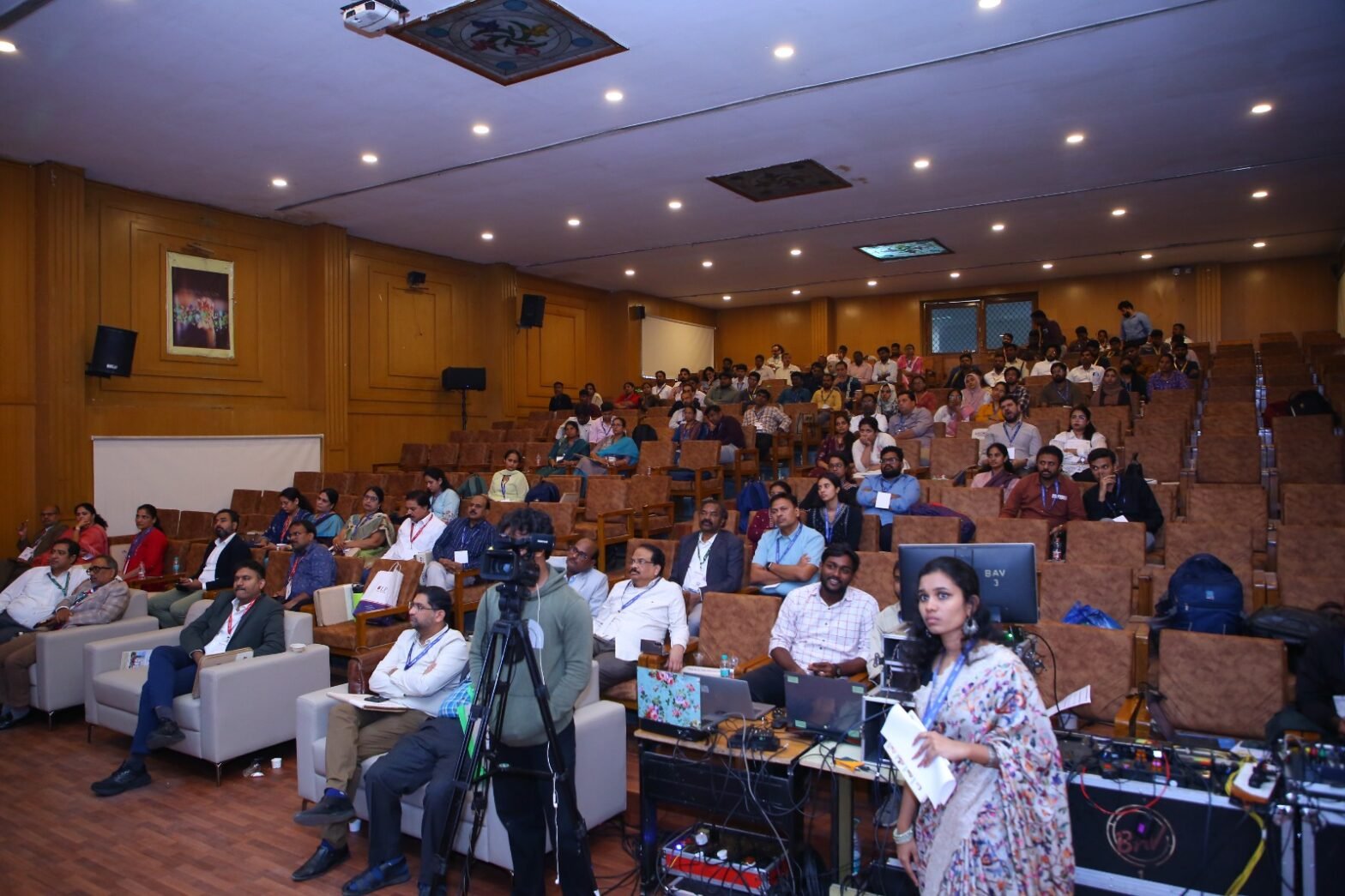
On Sunday, 22 November 2026, three rhinoplasty operations were performed at MicroCare ENT Hospital & Research Institute in KPHB and transmitted live to a full auditorium of surgeons at JNTU Hyderabad. The workshop was called RhinoSculpt 2026, and it was built on a simple conviction: you cannot learn rhinoplasty from a lecture any more than you can learn to swim from a diagram.
What RhinoSculpt 2026 was
RhinoSculpt 2026 was a one-day Live Rhinoplasty National Workshop organised by MicroCare ENT Hospital & Research Institute and Maurya Foundation, in association with the Association of Otolaryngologists of India (Telangana, Hyderabad and Andhra Pradesh chapters), and endorsed by the Rhinoplasty Society of India. The day carried 2 CME credits accredited by the Telangana State Medical Council.
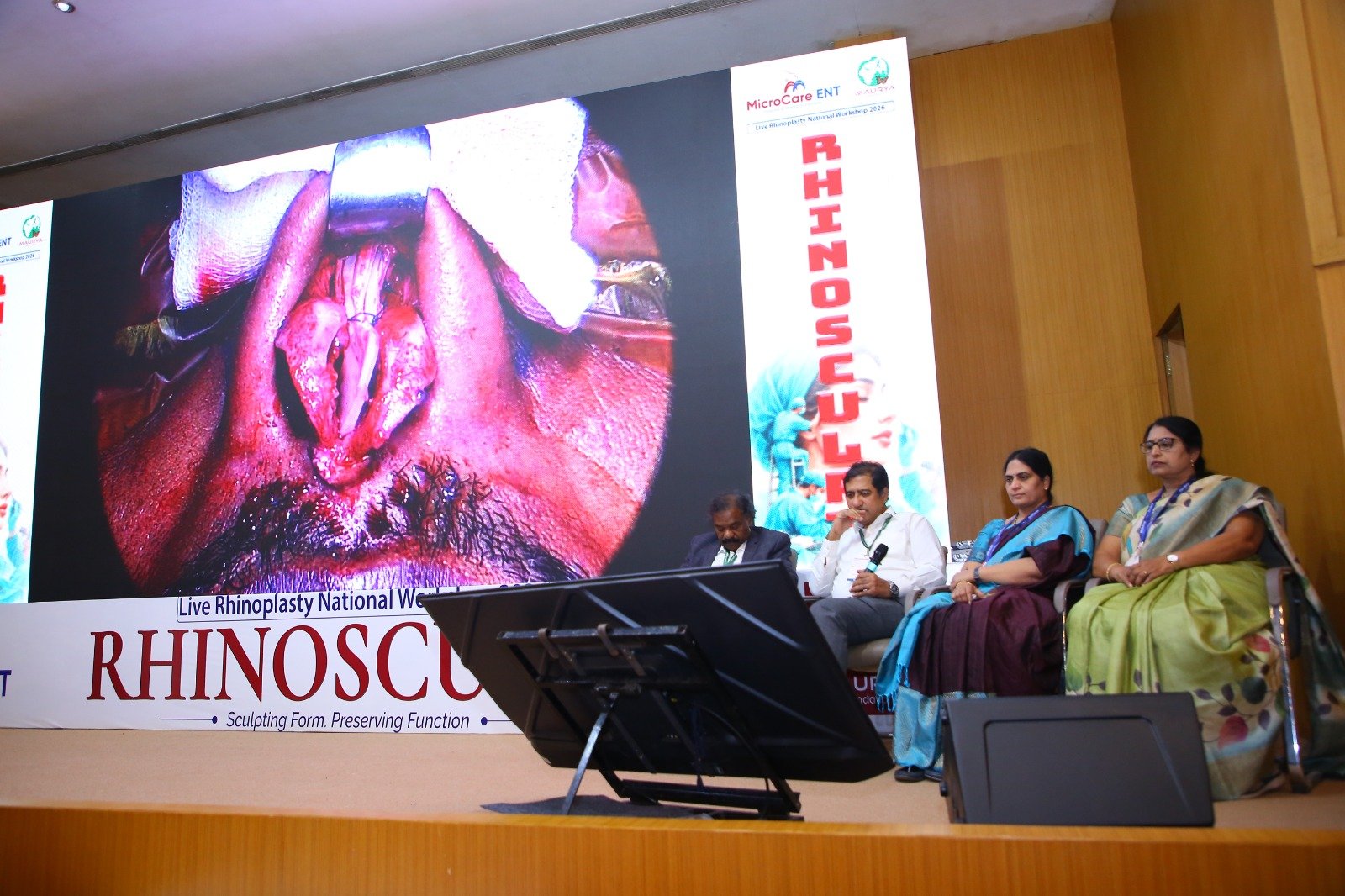
Delegates sat at the UGC Auditorium at JNTU Hyderabad. The surgery took place in our operating theatre at KPHB, with a one-way audio link running all day so that any delegate could put a question to the moderating surgeon while a step was being performed. Six scientific sessions ran around the three live cases: surgical anatomy and nasal analysis in the morning, graft harvest and tip dynamics between cases, an interactive quiz with the operating faculty after lunch, and complications, consent and an open forum to close.
Why live surgery, and not another lecture
Rhinoplasty is unusual among operations in that it demands precision and artistry at the same time, at the millimetre level, with very little margin for error in either. A slide deck can show you the finished result. It cannot show you the moment a surgeon decides that a spreader graft is not going to be enough, or how much cartilage to shave off a graft that is already in the nose, or what a collapsed tip actually feels like under the instrument.
Live transmission puts the delegate inside that decision. Every judgement call at RhinoSculpt was made in front of the room and explained as it was made, and the room was invited to challenge it. That is the part of surgical training that travels badly in any other format.
The three cases operated live
Five cases were worked up for the day and two were held in reserve, to be called only if a scheduled case had to be deferred on grounds of fitness. These three went ahead.
Case 1 — Revision open functional rhinoplasty
A patient presenting with both nasal deformity and nasal obstruction, with a history of three previous endoscopic sinus surgeries in 2013, 2015 and 2018. Examination showed a large nose with a broad nasal bridge and dorsum, a broad nasal base and a collapsed tip.
Dr. Sriprakash Vinnakota operated: osteotomies, spreader grafts, a septal extension graft, tip plasty, alarplasty and rib cartilage grafting. This was the longest case of the day, and deliberately so — revision rhinoplasty is where a surgeon has the least tissue to work with and the most to rebuild, and where the structural principles of the operation are most exposed.
Case 2 — Primary open rhinoplasty
A patient with no history of previous nasal surgery, presenting with a large nose, a broad nasal bridge and dorsum, a broad nasal base and a broad tip. Dr. Kshitij M. Patil operated, combining osteotomies and tip plasty with hybrid preservation and structural work — a demonstration of how preservation technique and classical structural technique can be used in the same nose rather than treated as rival schools.
Case 3 — Tip refinement in the thick-skinned Indian nose
A crooked nose deviated to the patient’s right, with a deviated nasal bridge and dorsum, mild broadness of the nasal base and an under-projected tip. Dr. Sriprakash Vinnakota and Dr. Kshitij M. Patil operated together: primary open rhinoplasty with osteotomies, a septal extension graft and tip plasty, with tip refinement specifically for thick skin.
Every patient was counselled that their operation would be transmitted live and recorded for teaching, and written informed consent was obtained in each case. No patient photographs were published in the delegate handbook, and delegates were asked not to photograph or record the projected images or the operative feed.
The thread running through the day: the Indian nose
The Indian nose has its own architecture, and it does not respond well to surgical ideals borrowed from elsewhere. Thicker skin hides definition that a surgeon has carefully created underneath it. Softer cartilage gives way where stiffer cartilage would hold. A less defined tip needs structural support rather than simple reduction. Techniques that produce a crisp result on thin European skin can produce a shapeless one here, and techniques that over-reduce can leave a nose that looks refined at six weeks and collapsed at two years.
That is why all three cases were chosen from our own practice rather than curated for how photogenic they would be, and why tip refinement in thick skin was given a full session of its own. Indian surgeons have innovated around these problems for years, but often in isolation, and rarely with the chance to watch one another work.
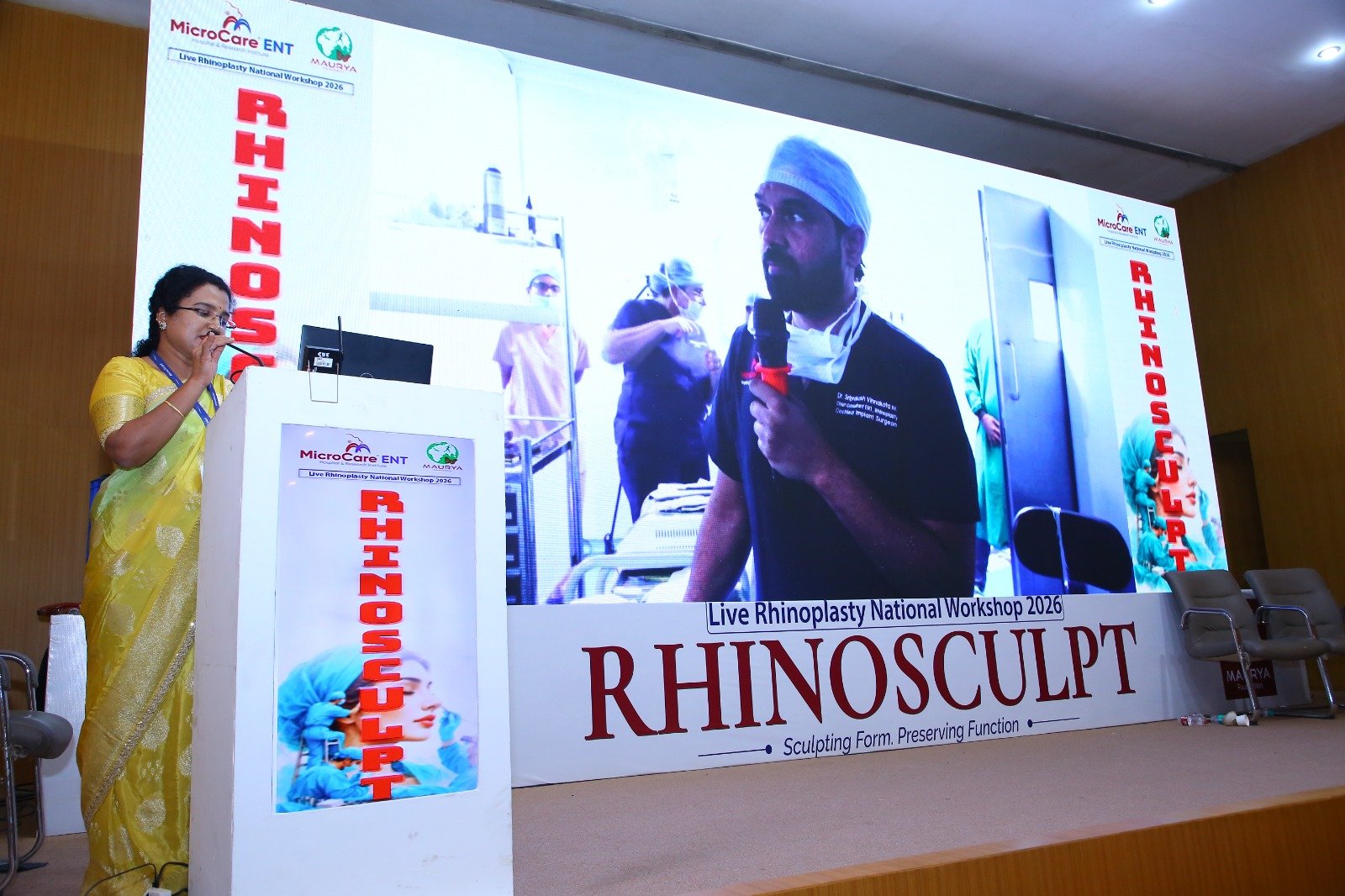
The operating faculty
Prof. Dr. Sriprakash Vinnakota was Organising Chairman and operating faculty. He is a Senior Consultant in ENT, Head & Neck Surgery with a focused practice in rhinoplasty, endoscopic sinus surgery, micro ear surgery, sleep apnoea surgery and cochlear implantation, and the founder of MicroCare ENT Hospital & Research Institute in 2003. His fellowship training includes endoscopic sinus and skull base surgery at the University of Graz, micro ear and cochlear implant surgery at the House Ear Institute in Los Angeles, and snoring and sleep apnoea surgery in Norway.
Dr. Kshitij M. Patil joined as operating faculty. A consultant ENT and rhinoplasty surgeon with more than twenty years in advanced functional and cosmetic rhinoplasty, he trained internationally under Prof. Dr. Wolfgang Gubisch in Stuttgart, and is a faculty member and keynote speaker at international ENT and rhinoplasty meetings.
The day was moderated and chaired by a large faculty drawn from across Telangana and Andhra Pradesh, with Dr. D. S. Deenadayal as Chief Advisor and moderator of the Quiz the Experts session, Dr. Chinny Sree as Organising Secretary, Dr. B Y C Maddaiah as Organising Treasurer and Dr. Ram Bhupal Rao as Convener.
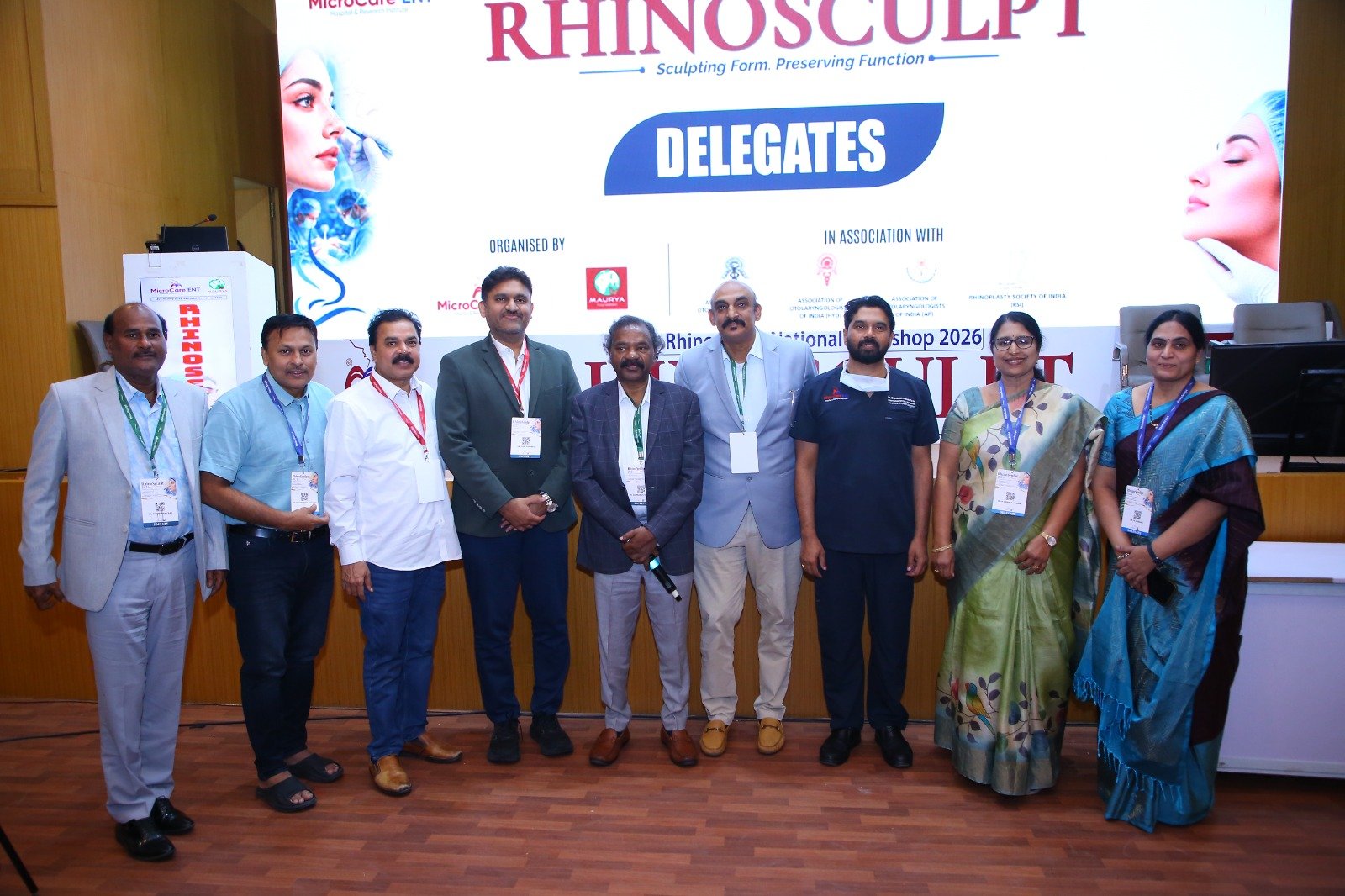
Beyond technique: consent, complications and medico-legal practice
Two sessions in the afternoon had nothing to do with instruments. Dr. D. S. Deenadayal spoke on the medico-legal aspects of rhinoplasty. Dr. Kshitij Patil spoke on patient selection, informed consent and screening for body dysmorphic disorder, and Dr. Sriprakash Vinnakota on the prevention and management of complications and revisions.
Those sessions matter more in rhinoplasty than in almost any other ENT operation. A technically excellent result can still be a failure if the patient was never a suitable candidate, or if what they wanted was never what the operation could deliver. Knowing when not to operate is part of the craft.
Thank you
Thank you to every delegate who gave us a full day, and to the faculty and chairpersons who carried it. The live surgery drew the room in, the open forum ran past its time, and the hall stayed full to the last case — which, for a Sunday, is the only review that counts.
Our thanks to the operating faculty, to the theatre team working behind the camera, to JNTU Hyderabad for hosting us, and to the office bearers of AOI Telangana, AOI Hyderabad, AOI Andhra Pradesh and the Rhinoplasty Society of India. Above all, our thanks to the three patients who placed their trust in the team and allowed their surgery to be taught from.
If you are a patient reading this
RhinoSculpt was a workshop for surgeons, but the reason it could happen is the reason it matters to patients too: the rhinoplasty taught on that screen is the rhinoplasty we perform every week at MicroCare ENT. If you are considering surgery for the way your nose looks, the way it works, or both, read more about rhinoplasty at MicroCare ENT or book a consultation so your own nose can be assessed properly.
Details of our past and upcoming surgical workshops are on our workshops and CME page.