



Voice Change (Hoarseness): Causes, Symptoms and Treatment

Speech Therapy

Experiencing Voice Change and Hoarseness Symptoms

Voice Change (Hoarseness)

If you are looking for the Best Voice Change Hospital in Hyderabad, MicroCare ENT Hospital provides expert evaluation and treatment for Voice Change (Hoarseness), vocal cord problems, and other voice disorders under Prof. Dr. Sriprakash Vinnakota, MBBS, MS (ENT, Head & Neck). Hoarseness may make the voice sound rough, weak, breathy, strained, or different in pitch and can occur due to irritation or inflammation of the vocal cords.

Common causes of hoarseness include throat infections, excessive voice use, acid reflux, allergies, smoking, vocal cord nodules, polyps, and other laryngeal conditions.

At MicroCare ENT Hospital, hoarseness treatment in Hyderabad may include medication, voice therapy, reflux management, vocal care, or surgery depending on the underlying cause.

Published By microcareenthospitals.com / Updated: Sep 07, 2026

Causes of Hoarseness

Voice Change (Hoarseness) can occur when the vocal cords become irritated, inflamed, strained, or affected by an underlying medical condition. Some of the common causes of hoarseness include:

  • Common cold and viral infections: Upper respiratory tract infections can cause inflammation of the throat and vocal cords, resulting in temporary hoarseness.
  • Voice overuse or vocal strain: Speaking loudly, shouting, singing for long periods, or excessive talking can strain the vocal cords and cause a change in voice.
  • Acid reflux (GERD/LPR): Stomach acid can travel upward and irritate the throat and vocal cords, leading to persistent hoarseness, throat clearing, or voice changes.
  • Smoking: Tobacco smoke can continuously irritate the vocal cords and may contribute to chronic voice problems.
  • Allergies: Allergic inflammation, nasal congestion, and frequent throat clearing may affect voice quality.
  • Vocal cord nodules or polyps: Benign growths on the vocal cords can cause persistent hoarseness, particularly in people who frequently strain their voice.
  • Thyroid disorders: Certain thyroid conditions or thyroid-related problems may sometimes be associated with changes in the voice.
  • Neurological disorders: Conditions affecting the nerves that control the vocal cords may lead to weakness, altered pitch, or persistent voice changes.
  • Injury or trauma to the voice box: Trauma involving the neck, larynx, or vocal cords can affect normal voice production.

At MicroCare ENT Hospital, Hyderabad, patients experiencing persistent voice change, hoarseness, vocal cord problems, or voice disorders can undergo detailed evaluation to identify the underlying cause and determine appropriate treatment.

Symptoms of Voice Change (Hoarseness)

Hoarseness does not always mean complete loss of voice. The voice may sound or feel different from normal. Common symptoms include:

  • Rough or raspy voice
  • Breathy or weak voice
  • Strained voice
  • Change in the pitch of the voice
  • Unusually high- or low-pitched voice
  • Reduced or increased voice volume
  • Voice fatigue after speaking
  • Difficulty producing a clear voice
  • Frequent throat clearing
  • Throat discomfort associated with speaking

If hoarseness persists for more than 2–3 weeks, particularly without an obvious cold or throat infection, an ENT evaluation is advisable to identify the cause.

Precautions for Hoarseness

Simple voice-care measures can help protect the vocal cords and may reduce symptoms in many patients:

  1. Avoid smoking: Smoking irritates the vocal cords and can contribute to persistent hoarseness and other laryngeal problems.
  2. Avoid second-hand smoke: Passive exposure to tobacco smoke can also irritate the throat and vocal cords.
  3. Stay well hydrated: Drink adequate water throughout the day to help keep the throat and vocal cords hydrated.
  4. Limit excess caffeine and alcohol: These may contribute to dehydration in some people.
  5. Avoid excessive shouting or loud speaking: Give your vocal cords adequate rest and avoid unnecessary strain.

Diagnosis of Hoarseness

At MicroCare ENT Hospital, evaluation for persistent hoarseness begins by identifying the reason behind the voice change.

An ENT specialist may:

  1. Take a detailed history of the voice problem, including its duration, severity, lifestyle factors, medical conditions, and voice usage.
  2. Examine the throat, neck, larynx, and surrounding structures.
  3. Assess the quality, pitch, strength, and characteristics of the patient’s voice.
  4. Examine the vocal cords using laryngoscopy or endoscopic evaluation when required.
  5. Recommend additional investigations depending on the suspected cause. These may include imaging, thyroid tests, or biopsy when medically indicated.

Treatment for Voice Change (Hoarseness)

Hoarseness treatment depends on the underlying cause. There is no single treatment suitable for every patient.

Treatment may include:

  1. Voice rest and vocal hygiene: Reducing unnecessary voice use and avoiding shouting may help irritated vocal cords recover.
  2. Hydration: Adequate fluid intake can help maintain healthy vocal cord function.
  3. Treatment of infections or allergies: Appropriate medication may be prescribed when inflammation, infection, or allergy is responsible for the symptoms.
  4. Acid reflux management: Lifestyle changes and medication may be advised when reflux is contributing to chronic hoarseness.
  5. Smoking cessation: Patients who smoke are strongly encouraged to stop smoking to reduce continued irritation of the vocal cords.
  6. Voice therapy: Selected patients may benefit from professional voice therapy to improve voice production and reduce vocal strain.
  7. Treatment of vocal cord lesions: Vocal cord nodules, polyps, cysts, or other lesions may require specialized treatment depending on their type and severity.
  8. Voice or vocal cord surgery: Surgery may be considered when structural abnormalities or selected vocal cord lesions cannot be adequately managed with conservative treatment.

Voice Change (Hoarseness) Treatment in Hyderabad

Persistent voice changes should not simply be ignored or treated repeatedly without identifying the cause. At MicroCare ENT Hospital, Hyderabad, Prof. Dr. Sriprakash Vinnakota, MBBS, MS (ENT, Head & Neck) provides evaluation and treatment for hoarseness, vocal cord disorders, voice problems, and other ENT conditions.

Early assessment can help identify the underlying problem and guide appropriate treatment to protect both your voice and vocal cord health.

FAQs

1. What are the common causes of voice change or hoarseness?

Common causes of voice change (hoarseness) include viral infections, excessive voice use, acid reflux, allergies, smoking, vocal cord nodules or polyps, thyroid problems, and certain neurological conditions.


Hoarseness caused by a cold, throat infection, or temporary voice strain often improves within a few days. If hoarseness lasts for more than 2–3 weeks, it is advisable to consult an ENT specialist for evaluation.

Yes. Acid reflux, especially laryngopharyngeal reflux (LPR), can irritate the throat and vocal cords and may cause hoarseness, frequent throat clearing, coughing, or a sensation of something stuck in the throat.

An ENT specialist may examine the throat and vocal cords using laryngoscopy or endoscopic evaluation. Depending on the findings, additional tests such as thyroid investigations, imaging, or biopsy may be advised when necessary.


Treatment depends on the cause and may include voice rest, hydration, reflux treatment, allergy management, medication, voice therapy, smoking cessation, or surgery for selected vocal cord lesions or structural problems.

From MicroCare ENT Hospital to your inbox

Sign up for free and stay up to date on research advancements, health tips, current health topics, and expertise on managing health.

📞 Book Your Consultation Now

👨‍⚕️ Dr. Sriprakash Vinnakota (26+ Years of Experience)

Where Dr. Sriprakash Vinnakota Practices
Team of ENT Surgeons under Prof. Dr. Sriprakash Vinnakota provides advanced ENT, Head & Neck care at the following locations.

📍 MicroCare ENT Hospital – KPHB Colony, Kukatpally
Road No. 4, KPHB Colony, Hyderabad – 500072, Telangana, India

📍 Apollo Hospitals – Financial District
Financial District, Nanakramguda, Serilingampally, Hyderabad – 500032

📞 Book your appointment today: 9494940725 / 26
🌐 www.microcareenthospitals.com

Watch our Related Videos

ENT Doctor in Kukatpally: Expert ENT Care by Dr. Sriprakash Vinnakota

Speech Therapy

ENT specialist consultation at MicroCare ENT Hospital in Kukatpally KPHB Hyderabad

Looking for an Experienced ENT Doctor in Kukatpally?

Are you searching for an ENT doctor in Kukatpally for persistent sinus problems, ear infections, hearing loss, nasal blockage, throat problems, snoring, or voice changes?

Choosing an experienced ENT specialist is important when symptoms continue to return or begin affecting your breathing, hearing, sleep, communication, or everyday activities.

Dr. Sriprakash Vinnakota at MicroCare ENT Hospital, KPHB Colony, Kukatpally, Hyderabad, provides specialized diagnosis and treatment for a wide range of ear, nose, throat, sinus, hearing, and related conditions.

Published By microcareenthospitals.com / Updated: Aug 08, 2026

Dr. Sriprakash Vinnakota – ENT Specialist in Kukatpally

Dr. Sriprakash Vinnakota is an experienced ENT specialist providing consultation and treatment at MicroCare ENT Hospital in KPHB Colony, Kukatpally.

His clinical practice includes the evaluation and management of conditions affecting the:

  • Ear and hearing
  • Nose and sinuses
  • Throat and tonsils
  • Voice and vocal cords
  • Snoring and sleep-related breathing
  • Head and neck region

Patients looking for an experienced ENT doctor near KPHB and Kukatpally can seek specialist evaluation for both common and complex ENT problems.

What Conditions Does an ENT Doctor Treat?

An ENT doctor, also known as an otolaryngologist, specializes in medical conditions affecting the ears, nose, throat, and related structures of the head and neck.

Some of the most common reasons patients visit an ENT specialist in Kukatpally include recurring ear infections, sinusitis, nasal blockage, hearing difficulties, tonsil problems, voice changes, and snoring.

Let’s look at some of these conditions in detail.

1. Sinusitis and Chronic Sinus Problems

The inner ear contains delicate sensory cells that help transmit sound signals to the brain.

When sudden hearing loss occurs, these structures may be damaged due to:

  • Viral infections
  • Reduced blood supply
  • Autoimmune disorders
  • Inner ear inflammation
  • Neurological conditions

Delaying treatment may result in permanent hearing loss.

Studies show that treatment is most effective when started within the first few days of symptom onset.

Blocked Nose and Breathing Problems

Persistent nasal blockage can make sleeping, exercising, and even routine breathing uncomfortable.

Common causes include:

  • Deviated nasal septum
  • Enlarged turbinates
  • Nasal polyps
  • Allergic rhinitis
  • Chronic sinusitis
  • Structural nasal obstruction

3. Deviated Septum Treatment in Kukatpally

A deviated nasal septum occurs when the wall separating the two nasal passages is displaced to one side.

It may cause:

  • One nostril to remain blocked
  • Difficulty breathing through the nose
  • Mouth breathing
  • Snoring
  • Recurrent sinus problems
  • Disturbed sleep

When symptoms are significant and do not improve with appropriate medical management, septoplasty may be considered to correct the structural obstruction.

4. Ear Infection and Ear Pain Treatment

Persistent ear pain or repeated ear infections should not be ignored.

An ear specialist in Kukatpally can evaluate symptoms such as:

  • Ear pain
  • Ear discharge
  • Recurrent ear infections
  • Blocked ears
  • Reduced hearing
  • Ringing in the ears
  • Eardrum problems
  • Dizziness associated with ear symptoms

5. Hearing Loss Treatment in Kukatpally

Hearing loss may develop gradually, making the early symptoms easy to overlook.

Watch for signs such as:

  • Frequently asking people to repeat themselves
  • Difficulty understanding conversations
  • Increasing TV or mobile volume
  • Trouble hearing in noisy environments
  • Ringing or buzzing in the ears
  • Hearing better in one ear than the other

Patients looking for a hearing specialist in Kukatpally may require an ENT examination followed by appropriate audiological testing.

6. Throat and Tonsil Treatment

Recovery depends on:

  • Cause of hearing loss
  • Severity of damage
  • How quickly treatment begins

Many patients experience partial or complete recovery when treated early.

The sooner you seek care, the better the chances of restoring hearing.

Meet Our Expert ENT Specialist

👨‍⚕️ Prof. Dr. Sriprakash Vinnakota

MBBS, MS (ENT, Head & Neck Surgery)
Chief Consultant ENT Specialist & Microsurgeon

  • 26+ Years Experience
  • Expertise in Hearing Loss, Cochlear Implants, and Ear Disorders

  • Advanced diagnostic and treatment facilities

When Should You Visit an ENT Doctor?

  • Advanced ENT diagnostic technology
  • Experienced sinus specialists
  • Comprehensive sinus care
  • Personalized treatment plans
  • Convenient location in Kukatpally & KPHB

FAQs

Who is an ENT doctor in Kukatpally?

Dr. Sriprakash Vinnakota provides ENT consultation at MicroCare ENT Hospital in KPHB Colony, Kukatpally, Hyderabad, for ear, nose, sinus, throat, hearing, voice, and related ENT conditions.

Consider the doctor’s experience, expertise relevant to your condition, diagnostic facilities, treatment options, communication, and accessibility for follow-up care rather than relying only on promotional rankings.

MicroCare ENT Hospital is located in KPHB Colony, Kukatpally, Hyderabad, where patients can consult Dr. Sriprakash Vinnakota for ENT-related conditions.

An ENT specialist can evaluate chronic sinusitis, recurrent sinus infections, nasal blockage, nasal polyps, allergies, and structural nasal problems.

Sudden hearing reduction, ear fullness, tinnitus, dizziness, and muffled hearing are common warning signs.

From MicroCare ENT Hospital to your inbox

Sign up for free and stay up to date on research advancements, health tips, current health topics, and expertise on managing health.

📞 Book Your Consultation Now

👨‍⚕️ Dr. Sriprakash Vinnakota (26+ Years of Experience)

Where Dr. Sriprakash Vinnakota Practices
Team of ENT Surgeons under Prof. Dr. Sriprakash Vinnakota provides advanced ENT, Head & Neck care at the following locations.

📍 MicroCare ENT Hospital – KPHB Colony, Kukatpally
Road No. 4, KPHB Colony, Hyderabad – 500072, Telangana, India

📍 Apollo Hospitals – Financial District
Financial District, Nanakramguda, Serilingampally, Hyderabad – 500032

📞 Book your appointment today: 9494940725 / 26
🌐 www.microcareenthospitals.com

Watch our Related Videos

Viral Videos

Playlist

8 Videos

Signs Your Child May Need Speech Therapy

Speech Therapy

child receiving speech therapy at MicroCare ENT Hospital Hyderabad

Every child develops speech and language skills at their own pace. However, when speech development is significantly delayed or communication difficulties persist, it may be a sign that professional help is needed.

Speech therapy can play a crucial role in helping children improve their communication, language, and social interaction skills. Early intervention often leads to better outcomes and increased confidence.

At MicroCare ENT Hospital & Research Institute, Hyderabad, our speech and language experts help children overcome speech and communication challenges through personalized therapy programs.

Published By microcareenthospitals.com / Updated: June 13, 2026

What Is Speech Therapy?

Speech therapy is a specialized treatment that helps children improve:

  • Speech clarity
  • Language development
  • Pronunciation
  • Communication skills
  • Social interaction abilities
  • Voice quality

Speech therapists assess a child’s communication abilities and develop customized therapy plans based on their needs.

Why Early Detection Matters

Children learn language rapidly during their early years.

Identifying speech and language difficulties early can:

  • Improve communication skills
  • Support academic success
  • Enhance social interactions
  • Build self-confidence
  • Prevent long-term developmental challenges

Signs Your Child May Need Speech Therapy

1. Delayed Speech Development

One of the most common reasons parents seek speech therapy is delayed speech.

Your child may need evaluation if:

  • They say very few words compared to other children their age.
  • They are not combining words into short phrases by the expected age.

2. Difficulty Pronouncing Words

If your child frequently mispronounces sounds or words and is difficult to understand, speech therapy may help improve speech clarity.

Examples include:

  • Replacing sounds
  • Omitting sounds
  • Consistently unclear speech

3. Limited Vocabulary

Children who struggle to learn new words or have a significantly smaller vocabulary than their peers may benefit from professional assessment.

4. Difficulty Following Instructions

Language difficulties may affect a child’s ability to understand and follow age-appropriate instructions.

Examples:

  • Trouble following simple directions
  • Difficulty understanding questions
  • Frequent confusion during conversations

5. Stuttering or Repeating Sounds

Occasional repetition is normal during language development.

However, persistent stuttering, frequent repetition of sounds, or noticeable speech interruptions may require therapy.

6. Difficulty Forming Sentences

Children who struggle to put words together into meaningful sentences may have language development challenges.

7. Trouble Interacting With Others

Speech and language difficulties can affect:

  • Making friends
  • Participating in conversations
  • Expressing thoughts and emotions

8. Voice Problems

A child who consistently has:

  • A hoarse voice
  • Nasal speech
  • Unusual voice quality

should be evaluated by an ENT specialist and speech therapist.

9. Hearing Problems Affecting Speech

Hearing plays a major role in speech development.

Children with hearing loss may:

  • Speak less
  • Mispronounce words
  • Experience delayed language development

Early hearing assessment is essential.

10. Frustration While Communicating

Children who struggle to express themselves may become:

  • Frustrated
  • Withdrawn
  • Emotionally upset during conversations

Speech therapy can help improve communication confidence.

Common Causes of Speech Delays

Speech and language difficulties may be associated with:

1. Hearing Loss

Undiagnosed hearing problems can significantly impact speech development.

2. Developmental Delays

Some children develop communication skills more slowly than others.

3. Autism Spectrum Disorder

Speech and language delays may be one of several developmental concerns.

4. Neurological Conditions

Certain neurological disorders can affect communication abilities.

5. Oral-Motor Difficulties

Problems with the muscles used for speech can impact pronunciation and clarity.

When Should Parents Seek Help?

Consult a speech therapist or ENT specialist if:

  • Your child has delayed speech milestones
  • Speech is difficult for others to understand
  • Stuttering persists
  • Hearing problems are suspected
  • Social communication difficulties are present

The earlier the intervention, the better the outcome.

How Speech Therapy Helps

Speech therapy programs may focus on:

  • Improving pronunciation
  • Expanding vocabulary
  • Building language skills
  • Strengthening communication confidence
  • Enhancing social interaction skills

Therapy sessions are tailored to each child’s unique needs.

Meet Our Expert ENT Specialist

👨‍⚕️ ENT Specialists
🗣️ Speech-Language Pathologists
👂 Audiologists

We work together to identify underlying causes and provide comprehensive speech and hearing care.

Why Choose MicroCare ENT Hospital?

  • Experienced Speech Therapists
  • Comprehensive Hearing Evaluation
  • Child-Friendly Therapy Environment
  • Personalized Treatment Plans
  • Advanced Diagnostic Facilities
  • Locations in Kukatpally & KPHB Hyderabad

Final Thoughts

Every child develops differently, but persistent speech or language difficulties should not be ignored. Early recognition and timely speech therapy can make a significant difference in a child’s communication abilities, confidence, and overall development.

If you’re concerned about your child’s speech, schedule an evaluation with a speech therapist and ENT specialist for expert guidance.

FAQs

1. At what age should a child start speaking?

Most children begin saying simple words around 12 months and start combining words by age 2.

No. Some children develop later than others, but persistent delays should be evaluated.


Yes. Hearing difficulties are a common cause of speech and language delays.


The duration depends on the child’s specific needs and progress.


Yes. Early intervention often leads to better communication and developmental outcomes.

From MicroCare ENT Hospital to your inbox

Sign up for free and stay up to date on research advancements, health tips, current health topics, and expertise on managing health.

📞 Book Your Consultation Now

👨‍⚕️ Dr. Sriprakash Vinnakota (26+ Years of Experience)

Where Dr. Sriprakash Vinnakota Practices
Team of ENT Surgeons under Prof. Dr. Sriprakash Vinnakota provides advanced ENT, Head & Neck care at the following locations.

📍 MicroCare ENT Hospital – KPHB Colony, Kukatpally
Road No. 4, KPHB Colony, Hyderabad – 500072, Telangana, India

📍 Apollo Hospitals – Financial District
Financial District, Nanakramguda, Serilingampally, Hyderabad – 500032

📞 Book your appointment today: 9494940725 / 26
🌐 www.microcareenthospitals.com

Watch our Related Videos

Viral Videos

Playlist

8 Videos

Puberphonia Treatment: Voice Therapy vs Surgery | MicroCare ENT Hyderabad

Speech Therapy

puberphonia treatment explained

A high-pitched voice after puberty can feel stressful. It can also affect confidence. Many people avoid speaking in public. Some even feel uncomfortable during phone calls or meetings.

This problem is called puberphonia. It is also known as mutational falsetto. The condition is treatable in most cases. With the right care, the voice can become deeper and more stable.

Still, the best treatment depends on a few things. The age of the patient matters. The number of years the problem has continued also matters. Because of this, expert evaluation is important before choosing a plan.

This blog explains two main options. One option is voice therapy. The other option is surgery. You will also learn when each option is used.

Published By microcareenthospitals.com / Updated: Jan 03, 2025

Understanding Puberphonia Before Treatment

During puberty, the voice box grows. At the same time, the vocal cords become longer and thicker. Because of this natural change, the voice becomes deeper in most boys.

In puberphonia, the vocal cords often develop normally. However, the person continues using a higher pitch. This usually happens because of long-term voice habits. In addition, throat tension can keep the pitch high.

Emotional stress can also play a role. Sometimes, the person does not adjust to the adult voice pattern. As a result, the old voice becomes a fixed habit. Therefore, a voice evaluation is the first step.

Voice Therapy for Puberphonia

Why Voice Therapy Is the First Choice

Voice therapy is the most common treatment. It is safe and non-invasive. Also, it works best in teenagers and early cases. For many patients, it gives fast improvement.

A trained speech therapist guides the process. Step by step, the patient learns a lower and stable pitch. Over time, the voice becomes more natural. As a result, confidence often improves.

How Voice Therapy Works

Voice therapy helps correct how the voice is used. It usually includes:

  • learning the right pitch

  • improving breathing control

  • reducing throat tightness

  • building voice strength

  • improving voice stability

  • practicing daily speaking patterns

In addition, therapy focuses on making the new voice a habit. Because practice is important, home exercises are also given. Therefore, regular follow-up sessions help confirm stability.

Who Gets the Best Results With Therapy?

Voice therapy often works best when:

  • the condition is found early

  • the voice issue is not very old

  • the person practices regularly

  • the vocal cords are normal

Because of this, early treatment gives better and faster results.

How Long Does Voice Therapy Take?

The time needed depends on the patient. Some people improve in a few sessions. Others need a few weeks of therapy. However, consistent practice usually speeds up progress.

Results often depend on:

  • how long the problem has continued

  • how much tension the throat has

  • how regularly practice is done

  • how the voice responds to training

So, a specialist evaluation is always helpful.

Limits of Voice Therapy in Long-Standing Cases

Voice therapy works for many people. However, some adults may not get stable results with therapy alone. This is more common when the problem has continued for many years.

In such cases, the voice habit becomes strongly fixed. As a result, change may take more time. Sometimes the voice improves during sessions but returns later. Therefore, therapy may give only partial improvement in selected patients.

When this happens, surgery may be considered.

Surgery for Puberphonia (Selected Cases)

Is Surgery Common?

Surgery is not common for puberphonia. Most patients improve with voice therapy. Still, surgery may help in resistant cases. Because of this, surgery is usually considered only after therapy is tried properly.

When Is Surgery Considered?

Surgery may be considered when:

  • voice therapy is done correctly but results are limited

  • the condition has continued for many years

  • the voice remains unstable after therapy

  • a specialist confirms medical need

  • vocal cord function suggests resistance

Therefore, surgery is a second option, not the first option.

Why Surgery May Help in Resistant Cases

In long-standing puberphonia, muscle tension patterns may stay strong. Because of this, the voice may not settle into a stable adult pitch with therapy alone. In such cases, surgery may support pitch correction.

Before surgery, the ENT specialist will do:

  • detailed ENT evaluation

  • vocal cord examination

  • voice analysis

  • discussion about risks and benefits

Even after surgery, voice therapy may still be needed. This helps stabilize the final voice. So, follow-up care is important.

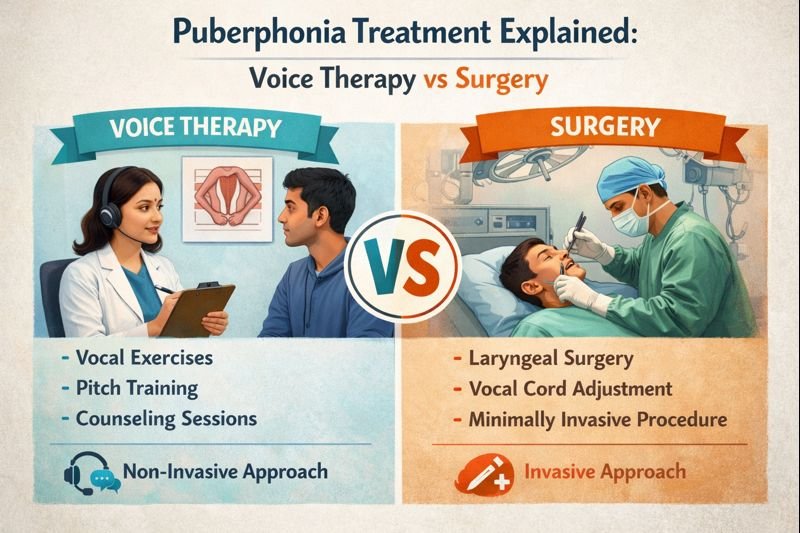
Voice Therapy vs Surgery: Key Differences

Voice Therapy

  • non-invasive

  • no downtime

  • best for early cases

  • improves voice through training

  • needs practice and follow-ups

Surgery

  • considered in selected resistant cases

  • useful when therapy fails

  • often used in long-standing adult cases

  • needs expert ENT voice surgeon evaluation

  • requires recovery and follow-up care

Important point: surgery is not a shortcut. Voice therapy after surgery may still be needed for best results.

Which Treatment Is Right for You?

The best option depends on:

  • your age

  • how long the issue has continued

  • voice evaluation results

  • response to therapy

  • any vocal cord concerns

Because of this, the safest approach is:

  1. start with voice evaluation and structured voice therapy

  2. consider surgery only if therapy is not enough and the specialist confirms need

A trusted ENT voice specialist will always guide you based on what is safest and most suitable.

Puberphonia Treatment at MicroCare ENT (Hyderabad / Telangana)

MicroCare ENT Hospital and Research Institute offers complete voice care. The approach includes:

  • ENT specialist evaluation

  • voice assessment

  • speech therapy support

  • personalized correction plans

  • surgery only for resistant cases

If you are looking for puberphonia treatment in Hyderabad or Telangana, MicroCare ENT provides expert, ethical, and patient-focused care.

FAQs

Is voice therapy enough?

In most cases, yes. Therapy works best when started early. However, long-standing adult cases may need more support.

When is surgery needed?

Surgery may be considered when the condition lasts for years and therapy does not give stable improvement.

Can adults improve?

Yes. Adults can improve with therapy. In resistant cases, surgery may be considered after evaluation.

Is surgery safe?

Surgery is usually safe when done by an experienced ENT voice surgeon. Proper evaluation is needed first.

Does surgery fix puberphonia permanently?

Many patients get long-term improvement. However, voice therapy after surgery may still be advised.

From MicroCare ENT Hospital to your inbox

Sign up for free and stay up to date on research advancements, health tips, current health topics, and expertise on managing health.

📞 Book Your Consultation Now

Call us: +91- 94 94 94 0725
appointments@microcareenthospitals.com
www.microcareenthospitals.com

To learn more about ent, visit our page on MicroCare ENT hospital

Watch our Related Videos

Viral Videos

Playlist

12 Videos

Puberphonia (High-Pitched Voice in Males): Causes, Symptoms & Treatment | MicroCare ENT Hyderabad

Speech Therapy

Puberphonia treatment with voice therapy at MicroCare ENT Hospital Hyderabad Telangana

A voice change is a normal part of puberty, especially in boys. Most teenage boys develop a deeper and more mature voice as they grow. However, some boys and young men continue to speak in a high-pitched or childlike or female voice even after puberty. This condition is called puberphonia.

If you or your family member is facing this issue, don’t worry. Puberphonia is treatable, and most patients show excellent improvement with the right expert guidance. At MicroCare ENT Hospital, Hyderabad, we offer structured voice evaluation and voice therapy for long-term improvement.

In this blog, we will explain what puberphonia is, why it happens, its symptoms, diagnosis, and the best puberphonia treatment options.

Published By microcareenthospitals.com / Updated: Jan 02, 2025

What is Puberphonia?

Puberphonia is a voice disorder where a boy or young man continues to use a high-pitched voice after puberty, even though the voice box (larynx) has developed normally.

In simple words: the body matures, but the voice does not shift into an adult male voice.

This condition is also known as:
Mutational falsetto
High-pitched voice after puberty

Puberphonia can affect confidence, social interactions, and professional communication. Many patients seek treatment after joining a new job or during major life events. The good news is that with proper treatment, the voice can become stable and natural.

Why Does Puberphonia Happen? (Main Causes)

In most cases, puberphonia happens due to functional and emotional factors—not because of a serious disease.

1) Functional Voice Habit

Some boys develop a habit of speaking in a higher pitch during puberty. Over time, the voice becomes fixed in that pattern even after physical growth is complete.

2) Psychological Factors

Anxiety, emotional stress, low confidence, or fear of adulthood can unconsciously trigger puberphonia.

3) Lack of Natural Pitch Transition

During puberty, vocal cords become longer and thicker. If the person does not adapt to the new vocal cord structure, the voice may remain high-pitched.

4) Rare Medical Causes

In some cases, delayed voice change may be linked to:

  • hormonal imbalance

  • thyroid problems

  • vocal cord structural issues

That is why an ENT specialist evaluation in Hyderabad is important.

Common Symptoms of Puberphonia

Some common signs include:
✅ High-pitched or childlike voice even after puberty
✅ Voice cracks while speaking
✅ Unstable voice tone
✅ Voice fatigue or strain after talking
✅ Difficulty speaking loudly
✅ Low confidence or embarrassment
✅ Avoiding social situations
✅ Complaints from family about “not sounding mature”

If these symptoms continue, consult an ENT voice specialist in Hyderabad for confirmation and treatment.

How is Puberphonia Diagnosed?

At MicroCare ENT Hospital Hyderabad, diagnosis is done through expert evaluation to confirm whether it is puberphonia or another voice disorder.

1) ENT Examination

The ENT doctor checks the throat, voice box, and structures to confirm normal development.

2) Voice Assessment

This may include:

  • pitch measurement

  • stability testing

  • breathing and resonance evaluation

3) Laryngoscopy (Vocal Cord Evaluation)

A laryngoscopy may be advised to clearly view vocal cords and rule out structural concerns.

4) Speech Therapist Review

A speech therapist checks voice habits and therapy needs for accurate planning.

Best Treatment for Puberphonia

  • The most effective and widely recommended treatment is voice therapy. It is safe, non-invasive, and proven.


    ✅ 1) Voice Therapy (Most Recommended)

    Voice therapy helps shift from high pitch to a stable adult male voice through guided exercises such as:

    ✅ pitch correction techniques
    ✅ breathing control exercises
    ✅ resonance training
    ✅ vocal strengthening exercises
    ✅ daily practice and stabilization methods

    Most patients begin noticing improvement quickly when therapy is done under expert supervision.


    ✅ 2) ENT-Guided Voice Training

    Some patients need combined ENT guidance and voice training—especially when they have used a high-pitched voice for many years.

    Treatment is personalized based on:

    • age

    • duration of the problem

    • voice pattern

    • confidence level


    ✅ 3) Surgery for Puberphonia (Selected Cases)

    Surgery is not commonly required, especially in teenage and early-stage cases. Most patients improve with structured voice therapy.

    However, in long-standing adult cases (especially after 20 years) where therapy results vary, selected patients may benefit from surgical correction.

    Surgery may be considered when:

    • Voice therapy does not provide adequate improvement

    • Structural or functional vocal cord concerns exist

    • Specialist evaluation confirms medical need

How Long Does Voice Therapy Take?

Treatment duration depends on:

  • how long the person had puberphonia

  • consistency of practice

  • individual voice response

Many patients improve within a few sessions, while others may need a few weeks of guided therapy. Results are often stable with proper follow-up.

Can Adults Treat Puberphonia?

Yes. Adults can successfully treat puberphonia. Many men seek treatment in their 20s or 30s due to:

  • workplace communication needs

  • social confidence issues

  • marriage-related concerns

  • personal self-esteem

With expert therapy and, if needed, ENT-guided interventions, adults can achieve a confident male voice.

When Should You Consult an ENT Voice Specialist?

You should consult an ENT voice specialist if:

✅ Your voice has not deepened after puberty
✅ Your voice affects confidence or communication
✅ You experience voice breaks or unstable tone
✅ You feel strain or fatigue while speaking
✅ Voice therapy has not helped enough
✅ You suspect vocal cord or hormonal issues

An experienced evaluation ensures accurate diagnosis and safe long-term improvement.

Puberphonia Treatment at MicroCare ENT (Hyderabad / Telangana)

At MicroCare ENT Hospital and Research Institute, we provide advanced voice disorder care with:

✅ expert ENT evaluation
✅ voice disorder assessment
✅ speech therapy support
✅ personalized voice correction plans
✅ ethical and evidence-based treatment

If you are searching for the Best ENT Hospital in Telangana for puberphonia care, our team is here to help.

Conclusion

Puberphonia is a condition where a high-pitched voice continues after puberty. It may affect confidence, communication, and quality of life. However, with the right diagnosis and expert voice therapy, most patients can achieve a natural and confident male voice.

✅ Get a Voice Evaluation
✅ Consult an ENT Voice Specialist at MicroCare ENT Hyderabad

From MicroCare ENT Hospital to your inbox

Sign up for free and stay up to date on research advancements, health tips, current health topics, and expertise on managing health.

📞 Book Your Consultation Now

Call us: +91- 94 94 94 0725
appointments@microcareenthospitals.com
www.microcareenthospitals.com

To learn more about ent, visit our page on MicroCare ENT hospital

Watch our Related Videos

Viral Videos

Playlist

10 Videos

Speech Therapy for Stuttering in Adults | MicroCare ENT Hospitals Hyderabad

Speech Therapy

Speech therapy for adult stuttering at MicroCare ENT Hospitals in Hyderabad Telangana

Stuttering in adulthood can feel frustrating and emotionally exhausting. Many adults avoid phone calls, meetings, interviews, or speaking in public because they fear getting stuck on words. However, the good news is this: speech therapy for adult stuttering can improve communication, reduce anxiety, and build long-term confidence.

At MicroCare ENT Hospitals in Hyderabad, our speech therapists and ENT specialists support adults who stutter with personalized therapy programs. In this blog, you’ll learn what adult stuttering is, why it happens, and how speech therapy can help.

Published By microcareenthospitals.com / Updated: Jan 01, 2025

Understanding Adult Stuttering (Stammering)

Stuttering (also called stammering) is a speech fluency disorder where the flow of speech breaks unexpectedly. This may include repeating sounds, stretching words, or feeling stuck. While many people start stuttering in childhood, some continue into adulthood.

Adult stuttering can also become more noticeable when stress, anxiety, fatigue, or pressure increases.

Common Signs of Stuttering in Adults

Adult stuttering may look different for different people. Common signs include:

  • Repeating sounds or syllables (ex: “b-b-because”)

  • Stretching a sound (ex: “ssssorry”)

  • Silent blocks (unable to start a word)

  • Facial tension, blinking, or jaw tightness

  • Avoiding certain words

  • Fear of speaking situations

  • Reduced confidence in communication

If these are affecting your work or personal life, seeking help from a speech therapist in Hyderabad can make a real difference.

Why Do Adults Stutter?

Adult stuttering does not happen because of “weak intelligence” or “lack of confidence.” It is often influenced by a combination of factors such as:

1. Brain and Speech Coordination

In people who stutter, speech timing and coordination may be less smooth, which affects fluency.

2. Genetic Factors

Stuttering can run in families. So, a family history may increase risk.

3. Stress and Emotional Triggers

Anxiety, pressure, or fear can worsen stuttering symptoms.

4. Habit and Avoidance Cycle

When adults avoid speaking, it increases fear, which can worsen stuttering later.

5. Rare Causes (Neurogenic Stuttering)

Some adults may develop stuttering after stroke, injury, or neurological conditions. That requires medical evaluation too.

Emotional Impact of Adult Stuttering (Very Common)

Adult stuttering can affect:

  • Self-confidence

  • Work performance

  • Social life

  • Relationships

  • Mental well-being

Many adults feel embarrassment or fear of being judged. Because of this, therapy must focus on both speech techniques and emotional support.

At MicroCare ENT Hospitals Hyderabad, therapy programs are designed to improve both fluency and communication confidence.

How Speech Therapy Helps Adult Stuttering Speech therapy does not promise “perfect speech overnight.” Inst

  • Improve speech flowReduce struggle and tension
  • Handle stuttering moments calmly
  • Build confidence during conversations
  • Reduce anxiety and speaking fear
    Improve communication skills for real-life situations

This is why stuttering treatment in Hyderabad works best when therapy is consistent and personalized.

Adult Stuttering Evaluation: What Happens First?

Before starting therapy, your speech therapist will assess your stuttering pattern through:

  • Your stuttering history (when it started, triggers)

  • Speech samples (conversation, reading, phone-style speaking)

  • Severity and frequency assessment

  • Emotional and social impact review

  • Your goals (interviews, meetings, public speaking, etc.)

After this, you receive a tailored therapy plan.

Best Speech Therapy Techniques for Adult Stuttering

Here are the most effective methods used in adult stuttering therapy:

1) Fluency Shaping Techniques

These help create smoother speech patterns such as:

  • Slow speaking rate

  • Gentle voice onset

  • Stretching syllables slightly

  • Relaxed breathing while speaking

2) Stuttering Modification Techniques

Instead of fighting stuttering, these techniques teach control:

  • “Cancellations” (correcting after a stutter)

  • “Pull-outs” (reducing struggle during stutter)

  • “Preparatory sets” (starting calmly before a tough word)

3) Breathing and Relaxation Training

Helps reduce throat tension and improves speech rhythm.

4) Confidence & Communication Training

This includes:

  • Handling phone calls

  • Speaking in meetings

  • Practicing real-life interactions

  • Improving eye contact and body language

5) Anxiety and Mindset Support

Because fear worsens stuttering, therapy often includes:

  • Reducing negative self-talk

  • Building coping strategies

  • Learning to speak confidently even when stuttering happens

At MicroCare ENT Hospitals (Hyderabad, Telangana), we check the nose safely and clearly. We may suggest:

  • Nasal endoscopy to see inside
  • Septum and valve assessment
  • Turbinate swelling evaluation
  • Recovery support plan
  • Functional correction if required

We focus on breathing safety first. Then we help you heal comfortably.

Home Practice Tips for Adults Who Stutter

Daily practice helps the most. Try:

  • Practice reading aloud for 5–10 minutes

  • Slow down speech intentionally

  • Use gentle starts for difficult words

  • Record yourself weekly to track progress

  • Practice speaking in safe environments first

  • Join support groups or practice sessions

Small steps every day lead to big progress over time.

When Should Adults See a Speech Therapist in Hyderabad?

You should consult a specialist if:

  • Stuttering affects confidence or work performance

  • You avoid speaking situations

  • You experience frustration, anxiety, or embarrassment

  • You want help for interviews, presentations, or public speaking

  • You have stuttering after a head injury or stroke

At MicroCare ENT Hospitals in Hyderabad, therapy is designed to be supportive, confidential, and practical.

Conclusion

Adult stuttering can feel challenging, but it does not have to control your life. With the right therapy and consistent support, adults can speak more comfortably and confidently.

If you are looking for speech therapy for adult stuttering, stammering treatment in Hyderabad, or a trusted speech therapist near you, MicroCare ENT Hospitals Hyderabad is here to help.

From MicroCare ENT Hospital to your inbox

Sign up for free and stay up to date on research advancements, health tips, current health topics, and expertise on managing health.

📞 Book Your Consultation Now

Call us: +91- 94 94 94 0725
appointments@microcareenthospitals.com
www.microcareenthospitals.com

To learn more about ent, visit our page on MicroCare ENT hospital

Watch our Related Videos

Viral Videos

Playlist

10 Videos

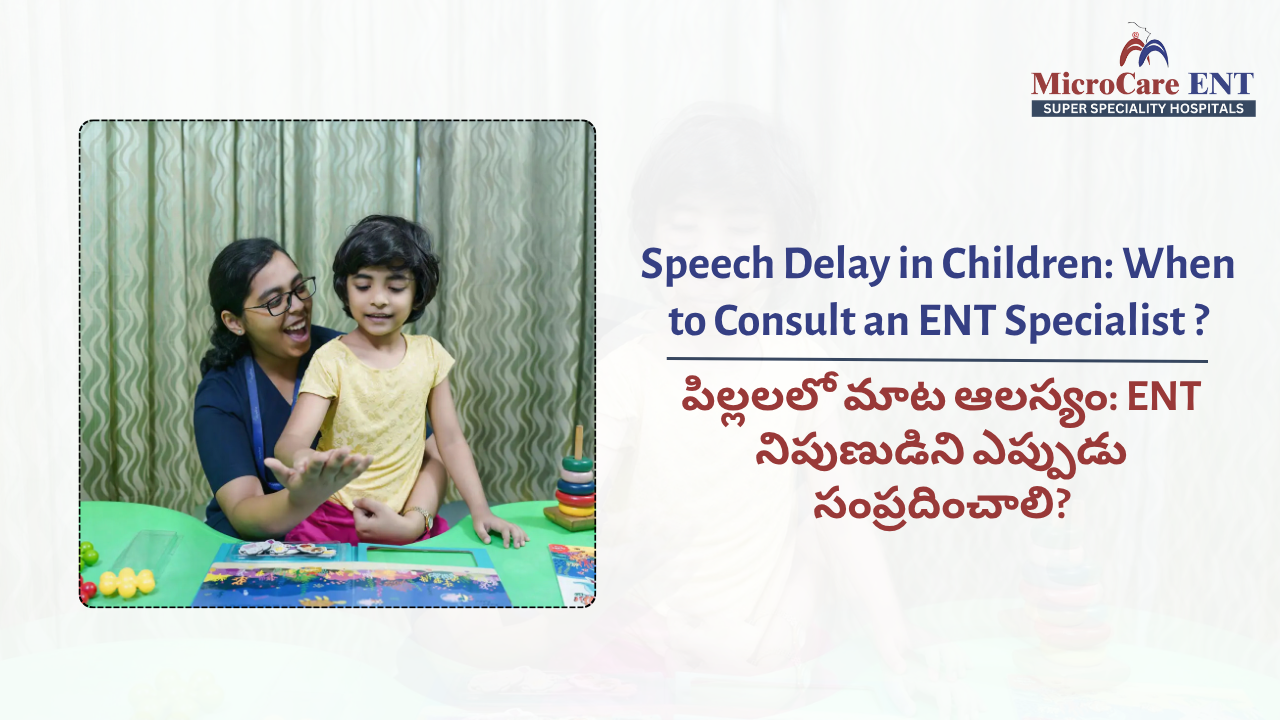
Speech Delay in Children—When to Consult an ENT Specialist?

Speech Therapy

speech delay in children ent evaluation and hearing check

speech delay in children

Speech delay in children is one of the most common concerns parents face during early childhood. While some children start speaking later than others, significant delays may point to an underlying hearing problem or ENT-related issue. At MicroCare ENT Hospital, specialists evaluate hearing, speech development, and ENT health to determine the exact cause and offer early, effective treatment.

Published By microcareenthospitals.com / Updated: OCT 18, 2025

🟧 What Is Speech Delay in Children?

Speech delay occurs when a child does not meet expected milestones for sound production, word formation, or communication. Early speech development relies on the child’s ability to hear and understand sounds. If hearing is affected, speech development slows down.

🟩 Common ENT-Related Causes of Speech Delay in Children

1. Hearing Loss

Even mild hearing loss affects how children recognize and learn speech sounds. Causes may include fluid in the ear, birth conditions, or recurring infections.

2. Chronic Ear Infections

Frequent ear infections muffle sound and interrupt language learning.

3. Glue Ear (Fluid Behind the Eardrum)

A major cause of speech delay in children, glue ear reduces hearing clarity and delays speech.

4. Tongue-Tie or Oral Structural Problems

Structural issues limit tongue movement and affect clarity of speech.

5. Enlarged Adenoids or Tonsils

Swollen tissues in the throat affect breathing, hearing, and speech development.

🟦 When to Consult an ENT Specialist

Visit MicroCare ENT Hospital if:

  • Your child isn’t using single words by 15–18 months

  • Speech is unclear after age 3

  • They don’t respond to their name or simple instructions

  • They have frequent ear infections

  • They seem to ignore sounds

  • Their speech progress suddenly slows or stops

Early evaluation ensures faster improvement and prevents long-term communication issues.

🟩 Signs Parents Should Watch For

Parents often notice small changes before a problem becomes obvious. The following signs may indicate a speech delay that needs ENT evaluation:

  • The child rarely makes eye contact

  • Minimal babbling as an infant

  • Limited vocabulary for their age

  • Difficulty imitating sounds or actions

  • Inconsistent responses to sounds

  • Prefers gestures over words

  • Hard to understand speech past age 3

  • Avoids social interaction or play

If multiple signs appear together, early evaluation at MicroCare ENT Hospital is recommended.

🟩 Role of Speech Therapy in Child Development

Speech therapy plays a crucial role in improving communication and pronunciation. A trained speech therapist:

  • Helps children build vocabulary

  • Improves clarity of speech

  • Teaches correct sound production

  • Strengthens oral muscles for speaking and feeding

  • Builds confidence in communication

For best results, ENT doctors and speech therapists at MicroCare ENT Hospital work together to provide a complete treatment plan.

🟧 How ENT Specialists Diagnose Speech Delay in Children

ENT doctors at MicroCare ENT Hospital use multiple tests to identify the cause:

  • Hearing evaluation (OAE, BERA, Audiometry)

  • Ear examination for fluid or infection

  • Nasal & throat assessment

  • Evaluation for allergies affecting hearing

  • Speech and language assessment

🟦 Conclusion

Speech delay in children can be managed effectively when diagnosed early. ENT specialists at MicroCare ENT Hospital offer accurate diagnosis and child-friendly treatment, helping children develop clear and confident speech.

To learn more about related ENT conditions and treatments, explore our detailed guides on Sinus Treatment Causes & Remedies, Tonsils Treatment in Hyderabad, and our complete range of ENT Services offered at MicroCare ENT Hospital.

From MicroCare ENT Hospital to your inbox

Sign up for free and stay up to date on research advancements, health tips, current health topics, and expertise on managing health.

📞 Book Your Consultation Now

Call us: +91- 94 94 94 0725
appointments@microcareenthospitals.com
www.microcareenthospitals.com

To learn more about ent, visit our page on MicroCare ENT hospital

Watch our Related Videos

Viral Videos

Playlist

8 Videos

The Importance of Speech and Hearing Therapy for Child Development

Speech Therapy

Importance of Speech and Hearing Therapy for Child Development

At Microcare ENT Hospital, we believe that early intervention plays a crucial role in shaping a child’s communication and cognitive skills. Child development through speech and hearing therapy is an essential step for children struggling with delayed speech, unclear pronunciation, or hearing problems.

By addressing these challenges early, children can build stronger communication skills, improve social confidence, and achieve success in learning and relationships.

Published By microcareenthospitals.com / Updated: OCT 05, 2025

👶 Why Speech and Hearing Therapy Matters in Child Development

The ability to listen, understand, and communicate forms the foundation for a child’s growth. Speech and hearing therapy supports child development by improving listening comprehension, sound recognition, pronunciation, and emotional expression.

Without timely intervention, hearing or speech delays can affect a child’s academic performance and social behavior.

The vocal cords (also called vocal folds) are two flexible bands of muscle tissue located in the larynx. When you breathe, they open to allow air passage, and when you speak or sing, they come together and vibrate to create sound.

These vibrations produce your unique voice tone, which is shaped by the mouth, tongue, and lips. Proper vocal cord health and voice care keeps these tissues flexible and well-lubricated, allowing effortless speech and singing.

🗣️ How Hearing Impacts Learning and Communication

Hearing problems in children often go unnoticed during early years. Mild hearing loss can make it hard to distinguish words, follow instructions, or develop correct speech sounds. Over time, this can lead to frustration and learning delays.

That’s why child development through speech and hearing therapy focuses on improving both listening and speaking abilities through expert guidance and interactive exercises.

💬 Signs Your Child Might Need Speech or Hearing Therapy

Parents should watch for these early indicators:

  • Limited vocabulary for age

  • Difficulty forming sentences

  • Mispronouncing words frequently

  • Not responding when called

  • Trouble following directions

  • Speaking too loudly or softly

  • Poor interaction or frustration while communicating

If your child shows these signs, it’s time to consult an ENT specialist or a speech-language pathologist at Microcare ENT Hospital.

🎓 How Speech and Hearing Therapy Helps Children

At Microcare ENT Hospital, our therapy programs combine medical expertise and child-friendly exercises to support overall growth. Here’s how speech and hearing therapy promotes child development:

1️⃣ Improves Pronunciation and Clarity

Therapists use repetition and sound practice to teach children how to form clear words and phrases.

2️⃣ Enhances Listening Skills

Through guided listening activities, children learn to identify and differentiate sounds, boosting auditory processing.

3️⃣ Boosts Academic Confidence

With improved communication, children perform better in school and express themselves confidently.

4️⃣ Encourages Emotional and Social Growth

Therapy improves interaction skills, helping children connect with peers and build positive self-esteem.

5️⃣ Develops Strong Cognitive Skills

Hearing and speech are directly linked to brain development; therapy strengthens memory, attention, and learning.

🎶 Special Voice Therapy and Treatment Options

1️⃣ Voice Therapy

Speech-language pathologists guide you through exercises to strengthen your voice and improve control.

2️⃣ Medical Management

Treatment of underlying causes like acid reflux, allergies, or infections can restore healthy vocal function.

3️⃣ Surgical Options

For nodules or cysts that don’t respond to therapy, minimally invasive voice surgery may be performed at Microcare ENT Hospital.

👩‍⚕️ Speech and Hearing Therapy at Microcare ENT Hospital

At Microcare ENT Hospital, our multidisciplinary approach ensures children receive complete care. Our team includes ENT specialists, audiologists, and certified speech-language pathologists.

Our Services Include:

  • Diagnostic Audiometry for early hearing assessment

  • Speech Evaluation Tests for speech and language clarity

  • Therapy for Stammering and Pronunciation

  • Auditory-Verbal Therapy for children with hearing aids or cochlear implants

  • Parent Training and Home Practice Guidance

🌱 Benefits of Early Intervention

The earlier therapy begins, the greater the progress. Early speech and hearing therapy can:

  • Prevent permanent speech delays

  • Support academic performance

  • Improve emotional balance

  • Build lasting self-confidence

  • Enhance parent-child bonding

👨‍👩‍👧 Parents’ Role in Supporting Speech and Hearing Development

Parents are the first teachers in a child’s journey to clear communication. At home, parents can:

  • Encourage reading and singing

  • Maintain regular conversations

  • Limit screen time

  • Model correct pronunciation

  • Follow therapist-recommended exercises

🏥 Why Choose Microcare ENT Hospital for Child Speech and Hearing Therapy

  • Expert ENT doctors, audiologists, and therapists under one roof

  • Modern diagnostic facilities and therapy tools

  • Personalized treatment plans for every child

  • Child-friendly environment and caring staff

  • Proven results in improving speech, hearing, and learning

💬 Conclusion

Every child deserves the ability to express, learn, and connect. Child development through speech and hearing therapy helps children overcome challenges and unlock their true potential.

At Microcare ENT Hospital, we are dedicated to providing advanced care that nurtures every child’s voice and listening abilities for a brighter, more confident future.

To learn more about related ENT conditions and treatments, explore our detailed guides on Sinus Treatment Causes & Remedies, Tonsils Treatment in Hyderabad, and our complete range of ENT Services offered at MicroCare ENT Hospital.

From MicroCare ENT Hospital to your inbox

Sign up for free and stay up to date on research advancements, health tips, current health topics, and expertise on managing health.

📞 Book Your Consultation Now

Call us: +91- 94 94 94 0725
appointments@microcareenthospitals.com
www.microcareenthospitals.com

To learn more about ent, visit our page on MicroCare ENT hospital

Watch our Related Videos

Viral Videos

Playlist

8 Videos

Speech Therapy in Hyderabad – Regain Confidence and Clear Communication

Speech Therapy

Speech Therapy in Hyderabad

At Microcare ENT Hospital, we believe that every voice deserves to be heard clearly. Our specialized speech therapy in Hyderabad is designed to help individuals struggling with speech clarity, stammering, articulation issues, and delayed speech. Through customized therapy sessions and advanced diagnostic techniques, our speech-language pathologists (SLPs) help children and adults regain confidence and communicate effectively.

Whether your challenge is mild stuttering or severe speech impairment, early evaluation and consistent therapy can make a life-changing difference.

Published By microcareenthospitals.com / Updated: OCT 23, 2025

🗣️ What Is Speech Therapy?

Speech therapy is a structured program led by certified speech-language pathologists aimed at improving communication skills. It involves exercises and techniques that strengthen the muscles used in speech and help individuals produce sounds accurately.

It also focuses on understanding language (receptive skills) and expressing it effectively (expressive skills). For children with speech delays and adults with neurological conditions such as stroke, speech therapy plays a crucial role in restoring everyday communication.

🧬 Common Speech and Communication Disorders Treated

At Microcare ENT Hospital, we provide therapy for a wide range of speech and language disorders, including:

  1. Stammering or Stuttering: Difficulty speaking fluently or maintaining rhythm.

  2. Articulation Disorders: Trouble forming certain speech sounds correctly.

  3. Voice Disorders: Strained, breathy, or hoarse voice due to vocal cord issues.

  4. Speech Delay in Children: Slow development of language milestones.

  5. Aphasia: Language impairment caused by brain injury or stroke.

  6. Resonance Disorders: Problems with airflow through the nose or mouth during speech.

  7. Dysarthria: Slurred or weak speech due to muscle weakness.

💬 How Speech Therapy Works

Speech therapy sessions are carefully tailored to each individual’s needs. The process generally includes:

  • Assessment: Detailed evaluation of speech, language, and cognitive skills.

  • Goal Setting: Creating a personalized therapy plan.

  • Exercises: Targeted techniques to improve articulation, breathing, and voice control.

  • Feedback and Monitoring: Continuous progress tracking and adjustment of exercises.

Our therapists use fun, interactive activities for children and evidence-based methods for adults to ensure consistent improvement.

🌱 Benefits of Speech Therapy

Effective speech therapy offers both emotional and functional benefits, including:

  • 1.Improved pronunciation and clarity

  • 2.Better self-confidence in communication

  • 3.Enhanced listening and understanding skills

  • 4.Increased participation in social and academic environments

  • 5.Recovery of speech after trauma, surgery, or stroke

👩‍⚕️ Why Choose Microcare ENT Hospital for Speech Therapy in Hyderabad?

At Microcare ENT Hospital, our dedicated team of speech-language pathologists and ENT specialists collaborate to provide comprehensive care. We offer:

  • 1.Advanced diagnostic tools for voice and speech evaluation

  • 2.Individual and group therapy sessions

  • 3.Specialized programs for children, adults, and professional voice users

  • 4.Supportive counseling for patients and families

  • 5.Proven results through consistent, evidence-based therapy

Our multidisciplinary approach ensures holistic improvement, both medically and psychologically.

⚕️ When to Consult a Speech Therapist

You should consider scheduling a speech therapy evaluation if you or your child experience:

  • 1.Difficulty in speaking or pronouncing words

  • 2.Frequent stammering or repetition of sounds

  • 3.Strained or hoarse voice

  • 4.Trouble understanding or forming sentences

  • 5.Sudden loss of speech after injury or stroke

The earlier therapy begins, the greater the chance for long-term improvement.

🩺 Speech Therapy for Children and Adults

Children’s Speech Therapy

Our child-focused speech therapy sessions involve games, storytelling, and repetition activities that make learning fun. They help improve pronunciation, listening skills, and vocabulary development.

Adult Speech Therapy

For adults recovering from a stroke, accident, or voice strain, our customized programs focus on regaining fluency, tone control, and expression.

💬 Conclusion

Clear communication builds confidence and connection. If you or your loved one are struggling with stammering, pronunciation errors, or delayed speech, it’s time to seek professional help.

At Microcare ENT Hospital, our expert team provides personalized speech therapy in Hyderabad to help you speak confidently, naturally, and clearly once again.

Take the first step toward a confident voice today — because every word matters.

To learn more about related ENT conditions and treatments, explore our detailed guides on Sinus Treatment Causes & Remedies, Tonsils Treatment in Hyderabad, and our complete range of ENT Services offered at MicroCare ENT Hospital.

From MicroCare ENT Hospital to your inbox

Sign up for free and stay up to date on research advancements, health tips, current health topics, and expertise on managing health.

📞 Book Your Consultation Now

Call us: +91- 94 94 94 0725
appointments@microcareenthospitals.com
www.microcareenthospitals.com

To learn more about ent, visit our page on MicroCare ENT hospital

Watch our Related Videos

Viral Videos

Playlist

8 Videos

Best Ear, Nose & Throat Hospitals Hyderabad – Top ENT Hospitals for Complete Ear, Nose & Throat Care

Speech Therapy

When it comes to maintaining good health, ear, nose, and throat care is often overlooked — yet these three areas play a crucial role in breathing, hearing, and communication. The Best Ear, Nose & Throat Hospitals Hyderabad are dedicated to providing specialized medical care for all ENT-related disorders, from common ear infections and sinus issues to complex surgeries like cochlear implants and head & neck procedures.

Hyderabad has become a major hub for advanced ENT treatment in India, with hospitals offering state-of-the-art facilities, skilled surgeons, and personalized patient care. Whether you’re struggling with chronic sinusitis, hearing loss, voice disorders, or sleep apnea, the Best Ear, Nose & Throat Hospitals Hyderabad provide comprehensive solutions using the latest technology and minimally invasive techniques.

Published By microcareenthospitals.com / Updated: OCT 16, 2025

1. MicroCare ENT Hospital – The Leading ENT Super Speciality in Hyderabad

MicroCare ENT Super Speciality Hospital is widely recognized as one of the Best Ear, Nose & Throat Hospitals Hyderabad for advanced treatments and compassionate care.

Expertise: Led by Dr. Sriprakash Vinnakota, one of Hyderabad’s most trusted ENT specialists.

Services Offered: Cochlear implants, endoscopic sinus surgery, allergy management, voice & throat disorders, ear microsurgery, and skull base surgeries.

Technology: Equipped with advanced endoscopic systems, laser-assisted instruments, and 3D navigation technology.

Infrastructure: Features four state-of-the-art operation theatres, dedicated audiology units, and modern ICUs.

Locations: Branches in KPHB and Jubilee Hills for patient convenience.

2. Dr. Rao’s ENT Super Specialty Hospital

Dr. Rao’s ENT Hospital is another reputed name among the Best Ear, Nose & Throat Hospitals Hyderabad, known for advanced ENT and skull base surgeries.

Specialties: Pediatric ENT, cochlear implants, head & neck oncology, rhinology, and facial plastic surgery.

Recognition: NABH accredited and equipped with advanced endoscopy labs.

3.MAA ENT Hospital

MAA ENT is a well-known ENT super specialty hospital in Hyderabad, with strong credentials in cochlear implantation, sinus surgeries, and ENT care. 

They report over 700 cochlear implant surgeries, many sinus surgeries, and advanced navigation / robotic laser tools.

4. Apollo Hospitals ENT Department

Apollo Hospitals, Jubilee Hills, ranks among the top ENT hospitals with advanced diagnostic and surgical facilities.

Services: Laser tonsillectomy, voice therapy, ear reconstruction, and hearing restoration surgeries.

Specialists: Houses top ENT surgeons like Dr. Y.L. Ravi Jadhav, renowned for cochlear implant procedures.

5.Continental Hospitals (ENT Department)

Continental Hospitals in Hyderabad has a dedicated ENT department offering comprehensive ear, nose, and throat treatments.

How to Choose the Right ENT Hospital in Hyderabad

When selecting from the Best Ear, Nose & Throat Hospitals Hyderabad, keep these factors in mind:

FactorImportance
Doctor ExperienceChoose hospitals with board-certified ENT surgeons.
InfrastructureModern operation theatres and diagnostics improve outcomes.
SpecializationLook for hospitals offering services like cochlear implants or allergy care.
Patient ReviewsReal feedback helps assess quality of service.
LocationAccessibility for follow-up care is key.

Conclusion

For anyone seeking the Best Ear, Nose & Throat Hospitals Hyderabad, MicroCare ENT Hospital stands as the top choice — known for expertise, technology, and patient trust. Alongside MicroCare, institutions like Dr. Rao’s ENT, Rainbow Children’s Hospital, and Apollo Hospitals continue to offer world-class ENT care. Choosing the right hospital can make a life-changing difference in hearing, sinus, or throat health.

From MicroCare ENT Hospital to your inbox

Sign up for free and stay up to date on research advancements, health tips, current health topics, and expertise on managing health.

📞 Book Your Consultation Now

Call us: +91- 94 94 94 0725
appointments@microcareenthospitals.com
www.microcareenthospitals.com

To learn more about ear, visit our page on advanced ear solutions at MicroCare ENT
learn about How snoring effects your health

Watch our Related Videos

Viral Videos

Playlist

8 Videos